Furniture that performs well in a European warehouse or a North American university dormitory can fail within 3–5 years in a Southeast Asian tropical environment. High ambient humidity — often 70–90% year-round in coastal cities — combined with temperatures of 28–35°C, salt air in coastal locations, and intense sunlight creates a demanding physical environment that separates well-specified furniture from poorly specified furniture very quickly.
For university procurement teams and developers in Vietnam, the Philippines, Malaysia, Indonesia, and Thailand, material selection is not an aesthetic decision — it is a durability and total cost of ownership decision. This guide explains which materials perform in tropical conditions and which do not, so your procurement specification protects your institution’s investment.
Table of Contents
ToggleWhy Tropical Conditions Degrade Furniture Faster
Three environmental factors drive accelerated furniture degradation in Southeast Asian dormitories:
1. Humidity
Relative humidity of 70–90% causes moisture absorption in porous materials. Wood-based panels expand, warp, and delaminate. Metal surfaces corrode. Upholstery absorbs moisture and develops mould. Edge sealing quality — the most commonly overlooked specification detail — determines whether a panel survives the first monsoon season or begins swelling at the edges within months.
2. Temperature Cycles
Daily temperature cycles of 10–15°C (from air-conditioned rooms at 22–24°C to ambient outdoor temperatures of 33–36°C when windows are open) create expansion and contraction cycles in all materials. Over time these cycles loosen joints, stress adhesive bonds, and crack surface finishes not designed for thermal movement.
3. Salt Air (Coastal Locations)
Universities in coastal cities — Manila, Ho Chi Minh City, Penang, Surabaya — face an additional challenge: salt-laden air accelerates metal corrosion dramatically. A powder coat specification adequate for inland locations may fail within 2–3 years in a beachfront dormitory.
Material Performance Guide for Tropical Dormitories
Steel and Metal Furniture (Beds, Frames, Lockers)
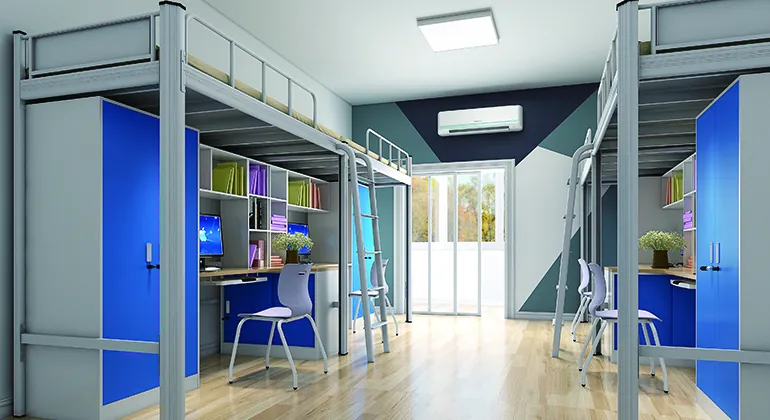
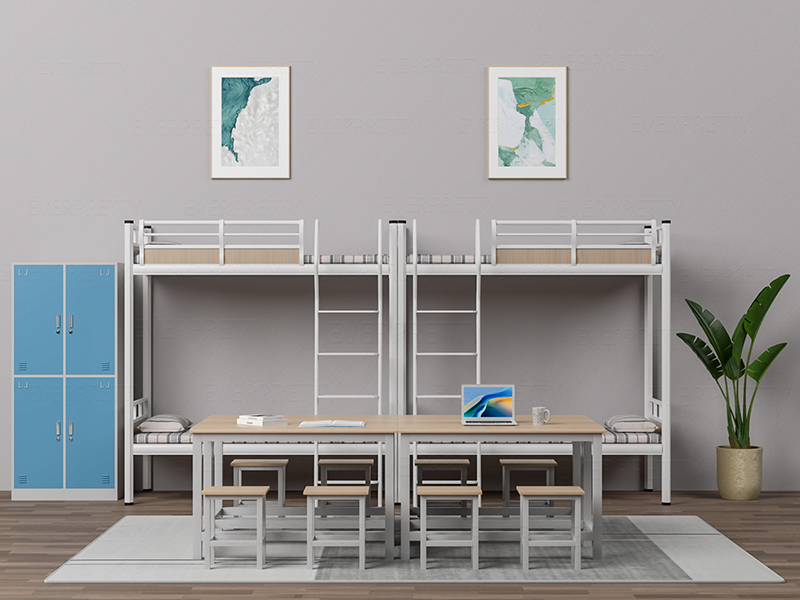
Steel is the recommended material for structural dormitory furniture — particularly bunk beds, loft beds, and locker systems — in tropical Southeast Asia. Its performance advantage over wood is significant in humid conditions. However, not all steel furniture is equal. The quality of the powder coat finish determines whether steel resists or succumbs to tropical corrosion.
| Specification | Tropical Performance | Recommendation |
| Powder coat, 40–50 microns | Marginal — degradation likely within 3–5 years in coastal areas | Minimum acceptable for inland, non-coastal locations |
| Powder coat, 60–80 microns | Good — adequate for most Southeast Asian inland dormitories | Standard specification for regional projects |
| Powder coat, 80–100 microns + salt spray tested | Excellent — suitable for coastal and high-humidity environments | Required for beachfront, port-city, and island projects |
| Galvanized steel + powder coat | Excellent — dual-layer protection for extreme environments | For outdoor furniture or extreme coastal conditions |
| Chrome plating (decorative) | Poor in tropical conditions — peels and pits rapidly | Avoid for Southeast Asian dormitory furniture |
Key specification to include in your RFQ: minimum powder coat thickness (60 microns standard; 80 microns for coastal sites) and salt spray test result (minimum 500 hours to ASTM B117 for standard specification).
Wood-Based Panels (Wardrobes, Desks, Cabinets)
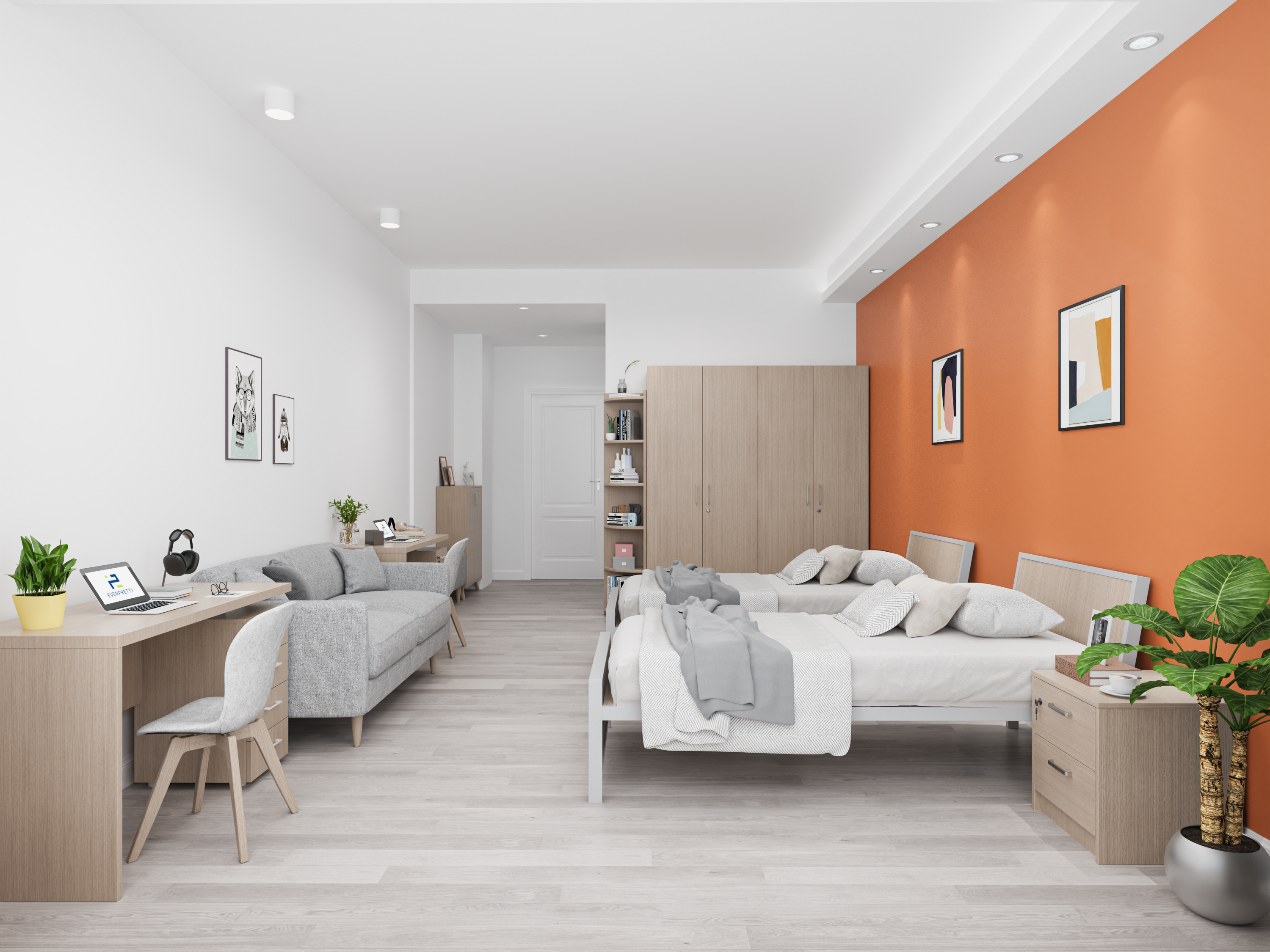
Wood-based panels — MFC (melamine-faced chipboard), MDF, and plywood — are the standard material for dormitory case goods (wardrobes, desks, cabinets) globally. In tropical conditions, the performance differences between panel types and specifications are significant.
| Panel Type | Tropical Performance | Verdict for SE Asia | |
| MFC board, 18mm, ABS edge banding 2mm | Good — moisture-resistant surface, sealed edges protect core | Recommended standard for Southeast Asia dormitory furniture | |
| MFC board, 15mm, PVC edge banding 1mm | Moderate — thinner core is more vulnerable; thin edge banding peels in humidity | Acceptable minimum for budget projects; upgrade edge banding to 2mm | |
| MDF (medium density fibreboard) | Poor — absorbs moisture readily; swells and loses structural integrity | Not recommended for Southeast Asia dormitory furniture | |
| Solid wood (teak, rubber wood) | Excellent (teak) to moderate (rubber wood) — natural resistance varies by species | Premium specification only; teak is excellent but expensive; rubber wood adequate if kiln-dried | |
| Plywood (18mm, marine grade) | Very good — cross-ply construction resists warping | Good for structural components; more expensive than MFC | |
| The Edge Banding Rule: The exposed edge of an MFC panel is the most vulnerable point in tropical conditions. Standard 1mm PVC edge banding can peel away from the substrate within 12–18 months in a humid environment, exposing the chipboard core to moisture absorption. Always specify 2mm ABS edge banding for Southeast Asian projects — it is a small cost difference with a large durability impact. | |||
Upholstered Furniture (Sofas, Chairs, Mattresses)
Upholstered furniture in tropical dormitories faces three specific challenges: moisture absorption into foam and fabric, mould growth in poorly ventilated rooms, and UV degradation from intense sunlight through windows. Fabric and foam selection significantly affects service life.
- Fabric: specify 100% polyester or solution-dyed acrylic (e.g., Sunbrella-type) for high-humidity environments. Avoid pure cotton or cotton-blend fabrics — they absorb moisture and support mould growth. Specify minimum 280gsm fabric weight for institutional durability.
- Foam: specify high-density foam (minimum 35kg/m³ for seating, 30kg/m³ for mattresses) with anti-microbial treatment. Open-cell foam allows moisture to evaporate; closed-cell foam traps it — specify open-cell for tropical environments.
- Mattress covers: specify waterproof or water-resistant mattress protectors as standard — this is universally recommended for student dormitories in tropical climates and dramatically extends mattress service life.
- Ventilation design: specify slatted bed bases rather than solid plywood bases for better airflow under the mattress — this reduces moisture accumulation and mould risk in the mattress core.
Hardware and Fittings
Hinges, drawer slides, handles, and screws are often overlooked in tropical specification — but hardware failure is one of the most common maintenance complaints in Southeast Asian dormitory facilities:
- Hinges: specify stainless steel or zinc alloy with nickel plating. Avoid standard steel hinges — they rust within 1–2 years in coastal or high-humidity environments.
- Drawer slides: specify cold-rolled steel with zinc coating (not chrome) or full-extension ball-bearing slides for better corrosion resistance.
- Handles: specify zinc alloy or stainless steel — avoid zinc die-cast with thin chrome plating, which pits and peels in humid conditions.
- Structural screws and cam locks: specify zinc-plated fasteners as minimum; stainless steel for coastal locations.
Specification Template for Tropical Southeast Asian Projects
Use this specification template as the basis for your RFQ to ensure suppliers quote to tropical-performance standards:
| Tropical Climate Specification Checklist Steel furniture (beds, frames, lockers): • Steel tube: minimum 40×40mm, 1.5mm wall thickness • Powder coat: minimum 60 microns (80 microns for coastal sites) • Salt spray test: minimum 500 hours (ASTM B117) for standard; 1,000 hours for coastal
Wood-based panel furniture (wardrobes, desks, cabinets): • Board: 18mm MFC, density minimum 680kg/m³ • Edge banding: 2mm ABS (not PVC) on all exposed edges • Formaldehyde emission: E1 standard minimum; E0 preferred • Back panel: minimum 5mm hardboard or MFC (not cardboard)
Upholstered furniture: • Fabric: minimum 280gsm polyester or solution-dyed acrylic • Foam: minimum 35kg/m³ density, open-cell, anti-microbial treatment • Mattress: waterproof cover standard; slatted base for ventilation
Hardware: • Hinges: stainless steel or zinc alloy, nickel plated • Drawer slides: zinc-coated cold-rolled steel or full-extension ball-bearing |
| Topohut Manufactures to Tropical Standards Topohut dormitory furniture has supplied dormitory furniture to tropical Southeast Asian projects for over 25 years. Our standard production specification is calibrated for tropical performance: 60-micron powder coat on all metal furniture, 18mm MFC with 2mm ABS edge banding on all panel furniture, and salt spray tested hardware. Share your project location and room type and we will confirm the appropriate specification for your climate conditions. Request a quote via our project inquiry page. |
Frequently Asked Questions
Can MFC board furniture be used in tropical climates?
Yes, with the right specification. 18mm MFC with 2mm ABS edge banding and properly sealed joints performs well in most Southeast Asian dormitory environments. The critical points are edge sealing quality and avoiding direct water contact. Standard MFC specification adequate for temperate climates (15mm board, 1mm PVC edge banding) is not recommended for tropical use.
Is solid wood better than steel for tropical dormitory furniture?
Not necessarily. High-quality teak or rubberwood performs well in tropical conditions, but solid wood furniture is significantly more expensive and can warp or crack if not properly kiln-dried and sealed. For most institutional dormitory applications, powder-coated steel beds and 18mm MFC wardrobes and desks deliver better value and durability at lower cost than solid wood alternatives.
How often does dormitory furniture need to be replaced in Southeast Asia?
With proper tropical specification (as outlined in this guide), quality dormitory furniture should last 10–15 years in standard use. Budget-specification furniture — particularly with thin edge banding, low-density foam, or inadequate powder coating — typically requires replacement or significant repair within 4–6 years. The cost of upgrading specification at procurement is almost always lower than the cost of early replacement.