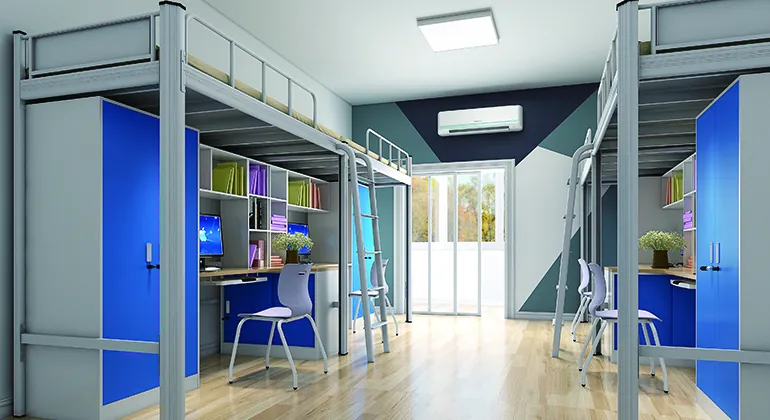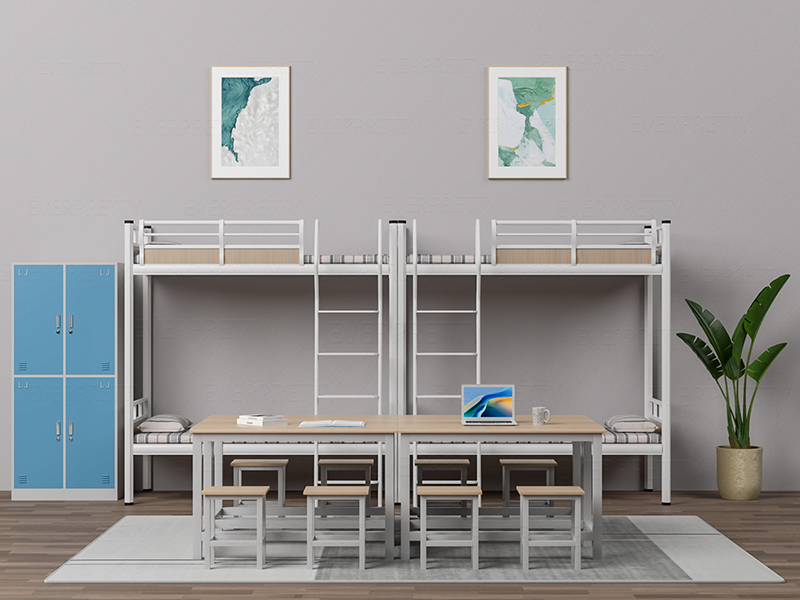
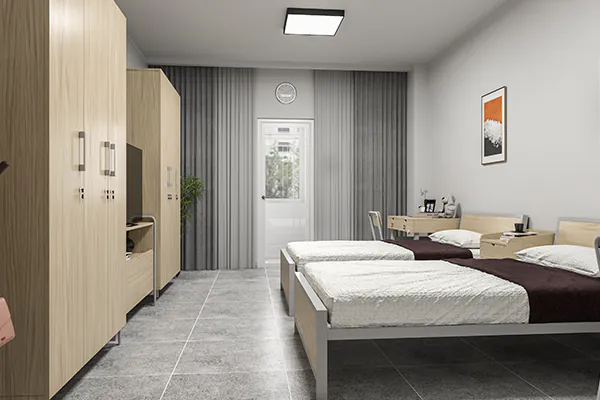
When budgeting for a dormitory furniture project, university procurement teams face a fundamental sourcing decision: buy locally or import from a China manufacturer? Both approaches have genuine merits — and both carry real risks if approached without the right information.
This guide gives university buyers, property developers, and project procurement teams an honest comparison of both options, so you can make the right decision for your specific project.
Table of Contents
ToggleThe Core Trade-Off
The decision between China and local sourcing typically comes down to three factors: unit cost, lead time, and perceived risk. Understanding how these factors actually play out in practice — rather than in assumptions — is the starting point for a good decision.
| Factor | China Factory (Direct) | Local SE Asia / Middle East Supplier |
| Unit cost (mid-range room set, FOB) | $400 – $650 | $700 – $1,200 |
| Customization (OEM/ODM, size, colour) | Full — design, colour, logo, size | Limited — usually catalog products only |
| MOQ | 100 units (factory direct) | Often lower, sometimes 1 unit |
| Production capacity | 500–5,000+ rooms/month | Typically under 200 rooms/month |
| Quality certifications | ISO, SGS, TUV, BV — widely available | Varies — often unverified |
| Lead time (production) | 30–45 days | 20–40 days |
| Sea freight to SE Asia | 10–18 days | N/A |
| DDP / door-to-door to project site | Available from specialist suppliers | Standard |
| Communication | English — varies by supplier | Local language |
| After-sales support | Depends on supplier | Easier in-country |
Cost: The Most Significant Difference
The price gap between factory-direct China furniture and locally purchased equivalents in Southeast Asia, the Middle East, and Africa is substantial — typically 35–55% lower for mid-range institutional quality. On a 200-room dormitory project, this translates to a saving of USD $60,000–$120,000 on furniture alone.
This gap exists because China’s furniture manufacturing ecosystem has scale advantages that local markets cannot replicate: raw material procurement at volume, specialized machinery, and a deep supply chain of components (hinges, slides, connectors) that keeps unit production costs low.
The cost advantage narrows — but does not disappear — when sea freight, import duties, and logistics are added. For most Southeast Asian markets, the total landed cost of China furniture (including freight and duty) remains 25–40% lower than local alternatives of equivalent specification.
Quality: Separating Perception from Reality
A persistent misconception is that locally sourced furniture is inherently higher quality than Chinese imports. In practice, quality is a function of specification and supplier selection — not origin.
China’s leading institutional furniture manufacturers hold the same international quality certifications — ISO 9001, SGS, TUV, Bureau Veritas — as suppliers in any other market. Many produce furniture that is exported to Europe, the US, and Australia under strict quality requirements. The challenge for buyers is identifying which suppliers meet institutional standards and which do not.
Local suppliers often have no independent quality certification at all. The assumption that local = higher quality is not supported by evidence; it reflects familiarity rather than verified performance.
| How to Verify Quality from a China Supplier: • Request certification documents: ISO 9001, SGS test reports, TUV or BV inspection certificates • Order samples before bulk production: physically inspect construction, finish, and hardware function • Commission a pre-shipment inspection: third-party inspector reviews production before it ships • Visit the factory: or request a live video factory tour — a good factory will welcome this |
Lead Time: Closer Than You Think
The common objection to China sourcing is lead time. In practice, the difference is smaller than most buyers expect:
- China production lead time: 30–45 days
- Sea freight to Southeast Asia: 10–18 days
- Customs clearance: 3–7 days
- Total China-to-site: 7–11 weeks
Compare this with local suppliers who often have 3–6 week production lead times for custom or bulk orders, plus local delivery. The total difference on a planned project is typically 2–4 weeks — not the months many buyers assume.
For projects with very tight timelines or small orders where speed outweighs cost, local sourcing has a genuine advantage. For projects with standard planning timelines of 3–6 months, China sourcing is entirely viable.
Customization: China’s Clear Advantage
If your project requires custom dimensions, specific colour schemes, branded logos, or non-standard configurations, China factory sourcing is significantly more capable than most local markets.
OEM and ODM services — where the factory produces to your design specification — are standard practice among China’s institutional furniture manufacturers. Services typically include:
- Free room layout design and product configuration planning
- Custom panel colours matched to Pantone or RAL codes
- Custom dimensions for non-standard room layouts
- Logo or branding integration into panels or hardware
- Custom packaging for branded projects
Most local suppliers in emerging markets offer catalog products with minimal modification. If your project requires design-led furniture or needs to match a specific interior scheme, China sourcing provides capabilities that local markets frequently cannot.
Risk Management: Addressing the Real Concerns
‘What if the quality is not what I expected?’
This risk is managed through sample approval and pre-shipment inspection — standard practices in China procurement. An approved sample creates a contractual quality benchmark; a PSI confirms production matches that benchmark before shipment. Local purchasing does not always offer equivalent assurance processes.
‘What if there are shipping delays?’
Delays do occur, but are manageable with realistic planning buffers (add 2 weeks to quoted lead times for first-time orders) and a supplier with a track record of on-time delivery to your market. Request evidence of past shipments to your destination country.
‘What if something is damaged or missing on arrival?’
Confirm in writing before ordering: the supplier’s policy on shortages and damage replacements, and whether marine cargo insurance is included in their DDP service. A reputable supplier will replace damaged items and ship shortages in the next available container.
When to Choose Local, When to Choose China
| Scenario | Better Option | Reason | |
| Large project, 100+ rooms, cost-sensitive | China factory direct | 30–50% cost saving, full OEM capability | |
| Very small project (<20 rooms), urgent | Local supplier | Lower MOQ, no freight lead time | |
| Highly customized design-led project | China OEM/ODM | Full design service, colour/size flexibility | |
| First-time buyer, risk-averse | China with DDP service | End-to-end managed by supplier | |
| Ongoing supply, replacement parts needed | Local preferred | Faster restocking, no import clearance | |
| Government project with local content requirement | Local preferred | Check regulatory requirements | |
| Why Topohut? Topohut — China furniture manufacturer has supplied dormitory furniture to universities, property developers, and government projects across Southeast Asia, the Middle East, Africa, and South America for over 25 years. We offer: • Full OEM/ODM service — free design, custom size, colour, branding • Door-to-Door DDP delivery direct to your project site — no freight forwarding needed • ISO, SGS, TUV, BV certified production — documentation provided • 5–10 year warranty on all products • English-speaking project team — no communication barriers Learn more about our factory & team or quality certificates & standards. | |||
Frequently Asked Questions
Is it safe to buy dormitory furniture from a China manufacturer?
Yes, with the right verification process: request certifications, order samples, and commission a pre-shipment inspection. These standard practices eliminate the vast majority of quality and supply risks.
How do I find a reliable China dormitory furniture factory?
Look for: 5+ years of export experience, verifiable certifications (ISO, SGS, TUV), English-speaking team, and a portfolio of completed projects in your target region. Request factory visit or video tour before placing a large order.
What is DDP and why does it matter?
DDP (Delivered Duty Paid) means the supplier handles everything — production, sea freight, import duties, customs clearance, and final delivery to your site. For university buyers without logistics experience, DDP removes the most complex parts of China sourcing and makes the process as simple as purchasing locally.