Small dormitory rooms are one of the most common challenges in student housing design. Whether you are working with 10m² compact singles, shared rooms where every centimetre counts, or older buildings where structural constraints limit layout options, the right furniture choices can dramatically increase usable space and improve the student living experience.
This guide covers the most effective space-saving furniture solutions for student dormitory rooms, with practical guidance on when to use each and how to specify them correctly for a large-scale project.
Table of Contents
ToggleWhy Space Efficiency Matters for University Dormitory Projects
Beyond student comfort, space efficiency has direct financial implications for dormitory operators. A room that accommodates 2 students instead of 1 doubles revenue per square metre. A layout that uses vertical space effectively allows smaller room footprints without sacrificing functionality — which can increase the number of rooms per building footprint.
For developers and university facilities teams, specifying the right space-saving furniture is both a student experience decision and a revenue optimization decision.
1. Bunk Beds: The Foundation of Space-Efficient Dormitories
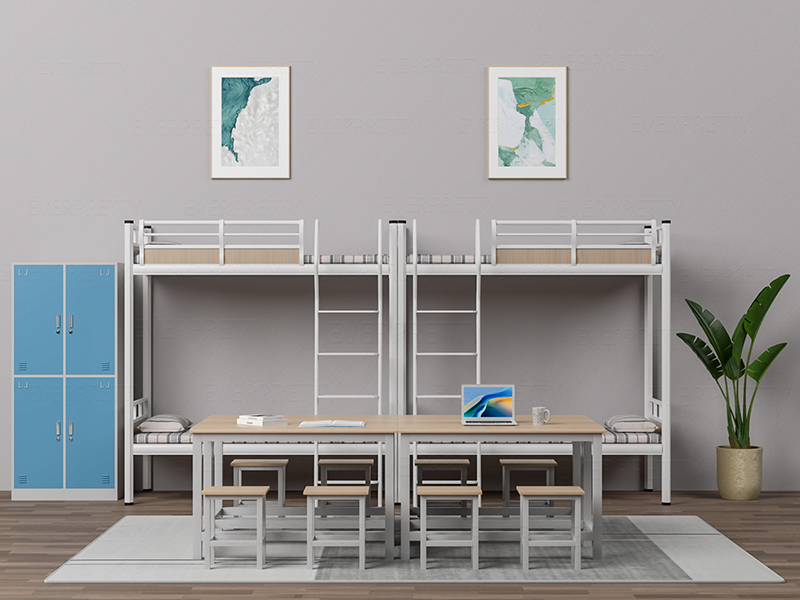
Bunk beds are the most fundamental space-saving solution in student dormitory design. By using vertical space, a standard bunk bed doubles sleeping capacity without increasing room footprint — the single most cost-effective space optimization available.
Standard 2-Tier Bunk Beds
Suitable for rooms from approximately 10m². The footprint is identical to a single bed (90×190cm or 100×200cm standard). A ceiling height of 220cm minimum is required for comfortable use; 240cm+ is recommended for student comfort on the upper bunk.
- Best for: shared double rooms in standard university dormitories and student hostels
- Cost saving vs two singles: approximately 30–40% lower total cost; significant footprint saving
- Key specification: guard rail height (min 20cm above mattress), ladder type, weight capacity per tier
Triple Bunk Beds
Triple bunks extend the vertical logic to three tiers, achieving the lowest cost-per-bed and smallest footprint-per-student of any bed configuration. They are the standard solution for student hostels, budget dormitories, and any project where maximum bed count per room is the primary objective.
- Ceiling height required: minimum 280cm; 300cm+ recommended
- Best for: hostels, budget university accommodation, worker quarters
- Key specification: tier spacing (min 75cm clear between tiers), guard rails on tiers 2 and 3, ladder angle and grip
2. Murphy / Wall Fold-Down Beds: The Ultimate Multi-Purpose Solution
A Murphy bed (also called a wall bed or fold-down bed) folds vertically into a wall cabinet when not in use, freeing the entire floor area for daytime activity. This transforms a small dormitory room from a sleeping space into a functional study and living space during the day.
For student housing in urban markets where room sizes are constrained, Murphy beds are increasingly the specification of choice for premium single-occupancy rooms, co-living units, and studio-style student apartments.
Murphy wall beds are particularly effective when combined with a fold-down desk integrated into the cabinet face — the desk folds down when the bed is up, creating a full work surface without any additional room footprint.
When to Specify a Murphy Bed
| Room Type | Murphy Bed Suitability | Notes |
| Studio single room (<15m²) | Excellent | Maximum daytime space recovery |
| Premium single occupancy | Excellent | High perceived quality, design-led aesthetic |
| Co-living individual unit | Excellent | Multi-purpose room use |
| Standard shared dormitory (2–4 students) | Not recommended | Operational complexity for shared rooms |
| Budget / high-turnover hostel | Not recommended | Maintenance demands; bunk bed preferred |
Murphy Bed Key Specifications
- Wall construction: confirm wall type (concrete, brick, or stud wall) before specifying wall-mounted Murphy bed — load-bearing capacity varies
- Lift mechanism: piston gas lift (most common, low maintenance) vs. spring counterbalance
- Integrated features: desk, sofa, shelving integrated into the cabinet unit
- Mattress thickness: Murphy mechanisms are rated for specific mattress weights — specify mattress before ordering cabinet
- Cabinet finish: should match overall room interior scheme
3. Loft / Open Loft Beds: Maximizing Floor Space in Single Rooms
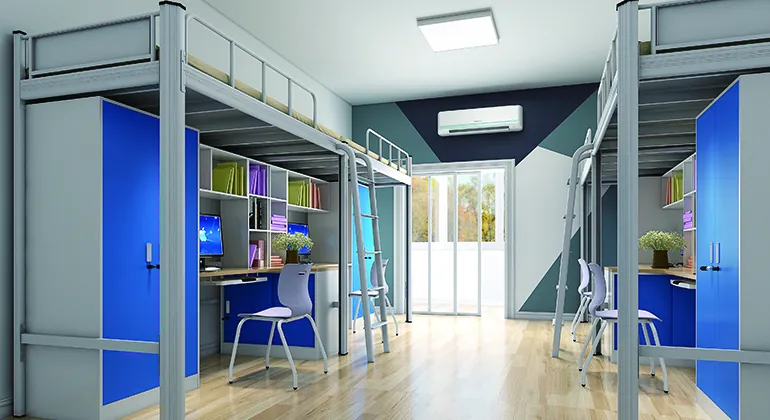
A loft bed elevates the sleeping surface to near-ceiling height, freeing the entire floor area beneath for a desk, storage, or seating. Unlike Murphy beds, the loft bed is always in position — making it simpler to operate and more suitable for standard dormitory use.
Open loft beds for compact rooms are the most popular solution for single-occupancy dormitory rooms where the priority is creating a functional study and living space without sacrificing a full-size bed.
Loft Bed Design Variations
- Study loft: desk and storage unit integrated beneath the elevated bed — the most space-efficient single-room configuration
- Open loft (L-shape): bed elevated on one end of the room; desk and wardrobe arranged below and alongside — maximizes natural light to the study area
- Loft with sofa: seating area beneath the bed — more suitable for premium residences or co-living units
Loft Bed Specifications to Confirm
- Clear height under loft: minimum 130cm for seated desk use; 160cm+ preferred
- Ceiling height required: loft platform height + mattress thickness + 75cm clearance above mattress = minimum ceiling height
- Ladder or staircase: integrated stairs with drawer storage is preferred for permanent student accommodation; ladder is acceptable for budget projects
- Guardrail: minimum 30cm above mattress surface on all open sides
4. Underbed Storage: Recovering Wasted Vertical Space
For rooms using standard single beds, the space beneath the bed is frequently wasted. Underbed storage drawers or wheeled storage units convert this dead space into practical storage — reducing the need for additional wardrobes or storage cabinets, and keeping the room less cluttered.
- Wheeled drawer units: pull out from under the bed; ideal for seasonal storage, luggage, and additional clothing. Specify minimum 25cm clearance under bed frame.
- Fixed platform with drawers: bed frame with integrated storage drawers — more stable, cleaner aesthetic, requires slightly more room height
- Specification note: not compatible with bunk beds (lower bunk clearance is insufficient). Best suited to single beds and Murphy beds.
5. Integrated Furniture Systems: The Highest-Efficiency Solution
For the highest level of space optimization, integrated furniture systems combine multiple functions into a single unit: bed + desk + wardrobe + storage in one modular structure that is designed specifically for the room’s dimensions.
Integrated systems are more expensive per unit but deliver the best space performance and a consistent, designed aesthetic. They are increasingly specified for premium student residences, branded co-living developments, and government-funded student housing projects where long-term durability and space efficiency are both priorities.
- Standard modules: elevated bed + desk with shelving + wardrobe + underbed storage — all in one L-shaped or U-shaped unit
- Customization: dimensions tailored to exact room footprint; OEM production required — a key strength of full-service suppliers like Topohut
- Lead time: longer than standard products — allow 40–55 days for OEM integrated systems
6. Compact Common Area Furniture
Space efficiency in dormitory projects is not limited to individual rooms. Common areas — study lounges, dining rooms, and reception areas — benefit from the same thinking:
- Stackable chairs: can be stacked 8–10 high for storage when not in use, allowing flexible multipurpose spaces
- Folding tables: for event or multipurpose spaces where dining and study areas share the same room at different times
- Bench seating: more space-efficient than individual chairs for dining areas — accommodates 20–30% more students per linear metre
- Wall-mounted desks and shelving: for corridor study nooks and compact study lounges — no floor footprint
Space-Saving Furniture by Room Size: Quick Reference
| Room Footprint | Occupancy | Recommended Bed Type | Key Space Savers |
| 8–12m² | 1 student | Murphy bed or loft bed | Wall-mounted desk, underbed storage |
| 10–14m² | 1 student | Loft bed with integrated desk | Wardrobe in loft system, wall shelving |
| 12–16m² | 2 students | Standard bunk bed | Shared wardrobe, underbed drawers |
| 14–20m² | 2–3 students | Bunk or L-shaped bunk | Individual lockers, compact study desks |
| 18–25m² | 3–4 students | Triple bunk + single | Locker system, shared desk bench |
Specification Checklist for Space-Saving Dormitory Furniture
Before ordering, confirm:
- Ceiling height of each room type — determines which bed configurations are viable
- Wall construction type (for Murphy beds and wall-mounted furniture)
- Door and corridor widths (for flat-pack delivery and assembly access)
- Room dimensions including any recesses, columns, or fixed fixtures
- Electrical outlet and switch positions (for desk lighting and charging integration)
- Ventilation and window positions (affects optimal bed placement and study area orientation)
| Free Room Layout Planning with Every Topohut Project Inquiry Topohut space-saving furniture includes a full range of space-efficient dormitory solutions: Murphy wall beds, open loft beds, triple bunk beds, integrated room systems, and underbed storage — all available with full OEM customization to your room dimensions. Share your room floor plans and we will provide: • Free room layout design with recommended furniture configuration • Itemized product specification matching your exact dimensions • Full project quote with unit pricing and total cost • Door-to-Door delivery to your project site
Browse murphy wall beds and open loft beds for compact rooms — or contact our team with your floor plans and room count for a free layout consultation. |
Frequently Asked Questions
What is the most space-efficient bed for a small student dormitory room?
For single-occupancy rooms under 12m², a Murphy wall bed recovers the most floor space (100% of the bed footprint during the day). For single rooms between 12–16m², a loft bed with integrated desk is the most practical balance of space efficiency and ease of use. For shared rooms, bunk beds are the standard solution — triple bunks for maximum density.
Are Murphy beds practical for university dormitories?
Murphy beds are practical for single-occupancy rooms in universities that have the facilities management capacity to maintain the lift mechanism. They are not recommended for shared rooms (operational complexity) or high-turnover budget hostels (higher maintenance frequency). For premium single rooms and co-living units they are an excellent choice.
What ceiling height is needed for a bunk bed in a dormitory?
For a 2-tier bunk bed, minimum ceiling height is 220cm — but 240cm+ is recommended for comfortable upper bunk use. For triple bunk beds, minimum ceiling height is 280cm. Measure from finished floor to ceiling, accounting for any beams or services that reduce clear height.
Can space-saving dormitory furniture be customized to my room dimensions?
Yes. Integrated furniture systems, loft beds, and Murphy beds are all available with full OEM customization through Topohut. Provide your room dimensions and we will design a furniture configuration that maximizes usable space within your specific footprint.