
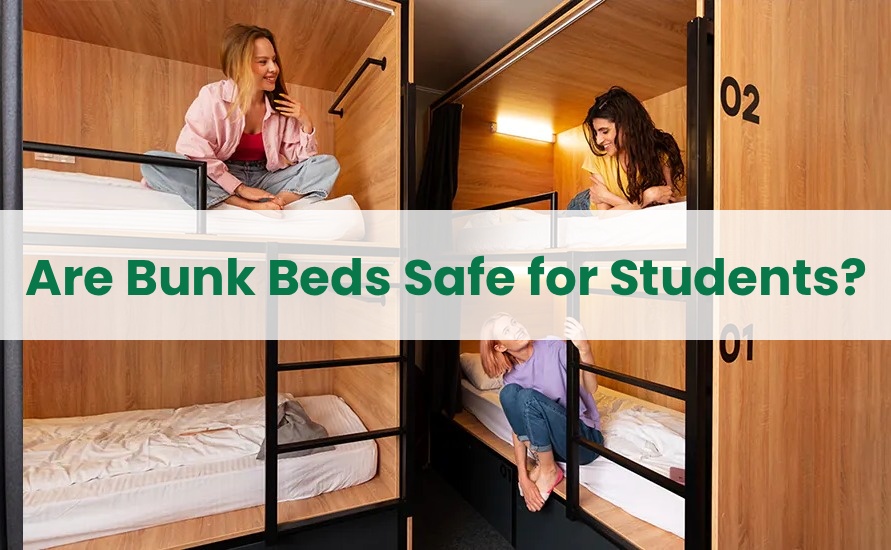
In student housing—from university dorms and boarding schools to shared apartments—bunk beds are a popular solution for saving space and reducing costs. Their compact design allows more students to live comfortably without expanding the building’s footprint.
So, are bunk beds safe for students? The answer is yes, but only when they meet modern safety standards, are assembled correctly, and are used responsibly. This article explores key risks and actionable safety measures.
Table of Contents
ToggleAre Bunk Bed Injuries Common?
Yes, more common than many realize. A 2018 study indicates that approximately 71,000 bunk bed–related injuries among 4- to 21-year-olds are treated in U.S. emergency rooms each year.
Children under six account for the majority of bunk bed–related injuries, likely due to their lack of coordination and hazard awareness. Additionally, there is a notable spike among 18- to 21-year-olds—mainly college students—who are twice as likely to suffer bunk bed injuries as teenagers aged 13 to 16. Alcohol consumption is also a contributing factor in school-related incidents.
The vast majority of injuries result from falls from the top bunk, leading to cuts, bruises, fractures, and sometimes traumatic brain injury.
Does this mean bunk beds are dangerous? In fact, no. Properly designed bunk beds that comply with modern safety standards are reasonably safe for students. That said, the data highlights that the risk increases significantly when beds are poorly designed, misused, or lack guardrails.
Key Risk Factors for Students Using Bunk Beds
Understanding why accidents happen is the first step to prevention.
1. Age and Behavior
- Age: Children under six lack the coordination and judgment to sleep on the top bunk and should never be assigned there.
- Behavior: Horseplay, jumping, or roughhousing on or under the bed is a leading cause of falls. Moreover, alcohol use significantly increases fall risk in college settings.
2. Common Hazards in Student Housing
Many dormitory and hostel setups contain hidden dangers:
- Missing or low guardrails: A top bunk without continuous guardrails at least 5 inches above the mattress surface is a major fall hazard.
- Mattress too thick: An overly thick mattress or mattress topper reduces the effective height of the guardrail, making it easier to roll over.
- Unstable frames: Loose bolts, missing slats, or poor welding can cause the bed to wobble or collapse.
- Gaps that trap head or torso: Dangerous openings between the guardrail and bed frame, or in the head/footboard, can trap a student’s head or neck (entrapment risk).
- Poorly attached ladders: Weak or unfastened ladders can slip or break, causing falls.
- Beds placed near hazards: Windows (fire escape obstruction or fall risk), ceiling fans, or low ceilings can cause injury.
Bunk Bed Safety Tips: How to Make Bunk Beds in Dorms “Safe”
You can dramatically reduce risks by following these four strategies.
1. Follow the Standards
The CPSC sets strict requirements for bunk beds sold in the U.S.:
- Guardrails on both sides of the upper bunk. The side against the wall must be continuous. When a guardrail is not fixed to the bed’s end, the gap to the nearest bed end must be ≤22 inches.
- Guardrail height: At least 5 inches above the mattress surface.
- Entrapment prevention: Any openings must pass tests with specific wedge blocks and a 9-inch rigid sphere to ensure they cannot trap a student’s head or neck.
2. Professional Assembly
- Assemble on a flat surface strictly following the manual. Do not use substitute parts.
- For complex or wall-fixed beds, hire a professional installer.
- After assembly, tighten all bolts and screws and verify that the bed and ladder are stable without wobbling.
3. Best Practices for Students
- No horseplay: Absolutely no jumping, hanging, or roughhousing on or around the bunk bed.
- Nighttime navigation: Install a small night light near the ladder to prevent falls during dark hours.
- Top bunk restrictions: No child under 6 onthe top bunk. Never exceed the manufacturer’s weight limit for the top bunk (typically 175–200 lbs for standard student bunks; check your bed’s label). Only one person at a time on top.
4. Regular Maintenance
- Tighten bolts every few months.
- Check slats for cracking or sagging (see next section).
When to Replace or Repair Bunk Beds
Even a well-made bunk bed wears out or becomes obsolete.
1. Warning Signs
Persistent creaking, excessive wobbling, or loose bolts that return shortly after tightening indicate structural decline. For wooden beds, creaking often means joints are weakening. For metal beds, it may signal worn connectors or bent tubing. If you see bent metal, cracked wood, or the bed sways significantly under normal use, it’s time to replace it.
2. Check the Slats
Remove the mattress and inspect the slats (mattress foundation). Look for:
- Cracks or complete breaks
- Sagging or bending when pressed
- Gaps that are too wide (causing the mattress to sink)
A broken slat can cause sudden collapse. Replace immediately or contact the manufacturer.
3. The Age Factor
- Material lifespan:
Wood bunk beds typically last 7–10 years; metal beds can last up to 15 years. Even if they look fine, hidden fatigue weakens the structure.
- Modern safety codes:
Older bunk beds may not meet the latest standards. Suppose the rules have been updated like this: guardrails increased to 6.5 inches (from 5), maximum gaps reduced to 3.5 inches (from 4), and guardrails added to all four sides of the top bunk, including the wall side. If existing bunk beds do not meet these requirements, new compliant beds would need to be purchased.
Why Choose Topohut for Safe, Dorm-Ready Bunk Beds?
When safety, durability, and compliance matter—especially for large institutions—choosing the right manufacturer is critical.
Topohut is a trusted dorm and apartment furniture solution provider with over 30 years of commercial furniture design and manufacturing experience. Here’s why educational institutions, hoteliers, and corporate housing operators rely on us:
- Massive production capacity: A 79,100 m² facility with 6 advanced production lines ensures consistent quality and timely delivery.
- Signature Interlock System: Our bed frames feature a unique interlocking design that simplifies assembly while providing exceptional structural integrity and stability.
- Global reach: Served 71,520+ customers in 68+ countries, including governments, the UN, major contractors, hotels, and universities like the University of Queensland and Sun Yat-sen University.
- Notable projects: Supplied furniture for the 2022 Qatar World Cup, NIMS University student apartments, and Qatar Gas staff accommodation.
- Rigorous certifications: An 18+ year certified manufacturer meeting ISO, SGS, TUV, BV, and CE international safety and quality standards. Also, an Alibaba-certified 5-star super supplier.
- 100% customization: Free project design, OEM/ODM, 3D modeling, and 24/7 project management.
- Flexible global logistics: Support for EXW, FOB, CIF, DDP terms via sea, air, train, truck, or express.
Conclusion
To conclude, bunk beds are safe when they are properly designed to meet standards, made from highly reliable materials, and used correctly. From ensuring weight limits for top bunk compliance to providing guardrails that meet the latest safety standards, Topohut builds safety into every frame.
Ready to upgrade your student housing with safe, code-compliant bunk beds? Contact Topohut today for a free consultation and custom quote!
Relevant information:
- https://www.campussafetymagazine.com/news/bunk-bed-accidents-account-for-71000-er-visits-each-year/125011/
- https://www.nationwidechildrens.org/research/areas-of-research/center-for-injury-research-and-policy/injury-topics/home-safety/bunk-bed-safety
- https://www.cpsc.gov/Business–Manufacturing/Business-Education/Business-Guidance/Bunk-Beds