

Optimizing dormitory space often necessitates lofted and bunk beds, yet this vertical expansion introduces critical safety risks. Beyond basic structural integrity, the bed guardrail for dorm beds serves as the primary defense against severe injury and institutional liability.
For accommodation operators, prioritizing superior guardrail design is not merely a purchasing decision—it is a fundamental governance strategy essential for student welfare.
Dorm Bed Fall Risks and Liability: Real-World Cases
The assumption that young adults are immune to rolling out of bed is a dangerous misconception. Exhaustion from academic rigor, narrow twin-XL mattress widths, and disoriented waking states create a dangerous combination of risk factors. The consequences of these incidents extend far beyond minor bruises, often resulting in catastrophic injuries that alter lives and damage university reputations.
Several high-profile cases highlight the severity of this risk:
- Georgia Tech (2015): Student Clark Jacobs suffered a life-altering fall from a lofted bed, resulting in a skull fracture and a brain bleed. He remained in a coma for months and required extensive rehabilitation to relearn basic motor functions. This incident spurred the formation of the “Rail Against the Danger” advocacy group to push for stricter safety measures.
- San Diego State University (2019): The tragic death of Dylan Hernandez following a fall from a bunk bed underscored the lethal potential of inadequate protection, raising serious questions about campus furniture standards.
- Valdosta State University: In a liability case involving a student injury, a court noted that while the danger of a lofted bed might be “open and obvious,” institutions still bear a responsibility to mitigate foreseeable risks to student safety.
These events serve as stark reminders: a simple bed rail for dorm bed setups is not an accessory; it is a critical safety barrier.
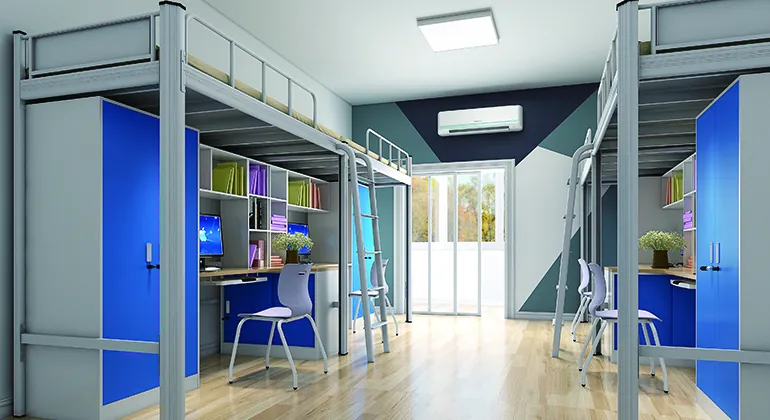
Understanding Bed Guardrail Safety Standards: The Regulatory Landscape
To manage liability, facility managers must first understand the legal minimums. The U.S. Consumer Product Safety Commission (CPSC) has established mandatory standards (16 CFR Parts 1213 and 1513) to prevent entrapment and falls.
Key CPSC Requirements Include:
- Height: The top of the guardrail must be at least 5 inches (127 mm) above the top surface of the mattress. This is crucial because thick mattress toppers used by students can effectively lower the protective height of the rail.
- Continuity: The rail on the wall-side (or side opposite the ladder) must be continuous between the bed’s end structures.
- Gap Restrictions: To prevent entrapment and strangulation, any opening between the guardrail and the bed structure must not exceed 3.5 inches.
- Structural Integrity: Rails must be securely attached and require intentional force or tools to remove.
While these regulations provide a baseline, “compliance” often equals the bare minimum. A 5-inch rise may be legally sufficient, but is it practically safe for a restless sleeper on a thick memory foam topper? Forward-thinking institutions are now looking for specifications that go beyond compliance.
How to Make Safe Guardrails: Materials and Structure
When considering bed rails for lofted beds or bunk beds, the material composition and structural engineering determine the longevity and actual safety of the product.
1. Steel vs. Wood
Regarding durability, high-hardness cold-rolled steel usually outperforms wood. Steel offers superior tensile strength and allows for slimmer profiles without sacrificing rigidity. Unlike wood, which can splinter or break under sudden impact, steel maintains its structural integrity even under significant stress, providing a reliable passive restraint system.
2. Structural Design
Guardrail architecture is governed by precise structural design mandates, including strict regulations on the gap size between the rail and mattress, the required length of the rail relative to the bed frame, and critical vertical height specifications.
When it comes to height, regulatory frameworks vary by region. The U.S. CPSC standard dictates a minimum guardrail height of 5 inches (approx. 127 mm) above the mattress surface.
In comparison, other standards such as China’s GB 28008-2024 stipulate that the safety rail’s top edge be at least 300 mm (approx. 11.8 inches) from the bed surface and no less than 200 mm (approx. 7.9 inches) above the top of the mattress.
Understanding these varying global benchmarks provides a broader context for evaluating safety features, particularly when accounting for modern student habits like adding thick memory foam toppers.
Beyond these dimensional considerations, the welding method of the guardrail, the specifications of the hardware used, and whether components are rounded or capped to prevent scratches are equally vital for preventing injury.
The Topohut Advantage: Your Reliable Partner in Safety
Navigating strict regulations requires a partner with specialized expertise. Topohut, a premier one-stop dorm & hostel furniture solution provider with over 30 years of experience, can be your best partner.
With over 30 years of experience, Topohut has been a reliable project partner for more than 51,520 clients globally. We have successfully delivered safe, durable furniture solutions to prestigious institutions such as the University of Queensland, NIMS University, and Sun Yat-sen University. Our commitment to safety is rigorous; our quality control systems strictly adhere to ISO, SGS, TUV, and BV international standards.
Furthermore, we offer more than just manufacturing. Our services encompass comprehensive project design, OEM & ODM customization, outlet planning, and 3D model construction for everything from single classrooms to entire dormitory buildings.
With extensive global logistics capabilities, we serve 68+ countries, offering flexible trade terms (EXW, FOB, CIF, DDP) and reliable shipping via sea, air, and rail.
Conclusion
Dorm bed safety goes far beyond basic compliance. A well-designed bed guardrail for bunk beds or lofted beds is an essential safeguard against serious injury and institutional risk. With proven expertise and global project experience, Topohut delivers safe dorm furniture solutions that exceed minimum standards. Contact Topohut to build safer, more responsible dorm environments.
Relevant information:
- https://braininjurypeervisitor.org/survivor-stories/clark-jacobs/
- https://www.nbcsandiego.com/news/local/family-of-sdsu-student-who-fell-from-dorm-room-bunk-bed-files-wrongful-death-lawsuit/2460308/
- https://www.lcwlegal.com/news/college-not-liable-for-students-fall-from-dorm-bed/
- https://www.enjuris.com/blog/news/injuries-from-loft-bed-falls/
- https://www.craft-child.com/blog/bunk-bed-safety-standards/
- https://www.law.cornell.edu/cfr/text/16/1213.3
- https://openstd.samr.gov.cn/bzgk/gb/newGbInfo?hcno=4E869C8EBF3CD4591D4F4DFD96D54185