
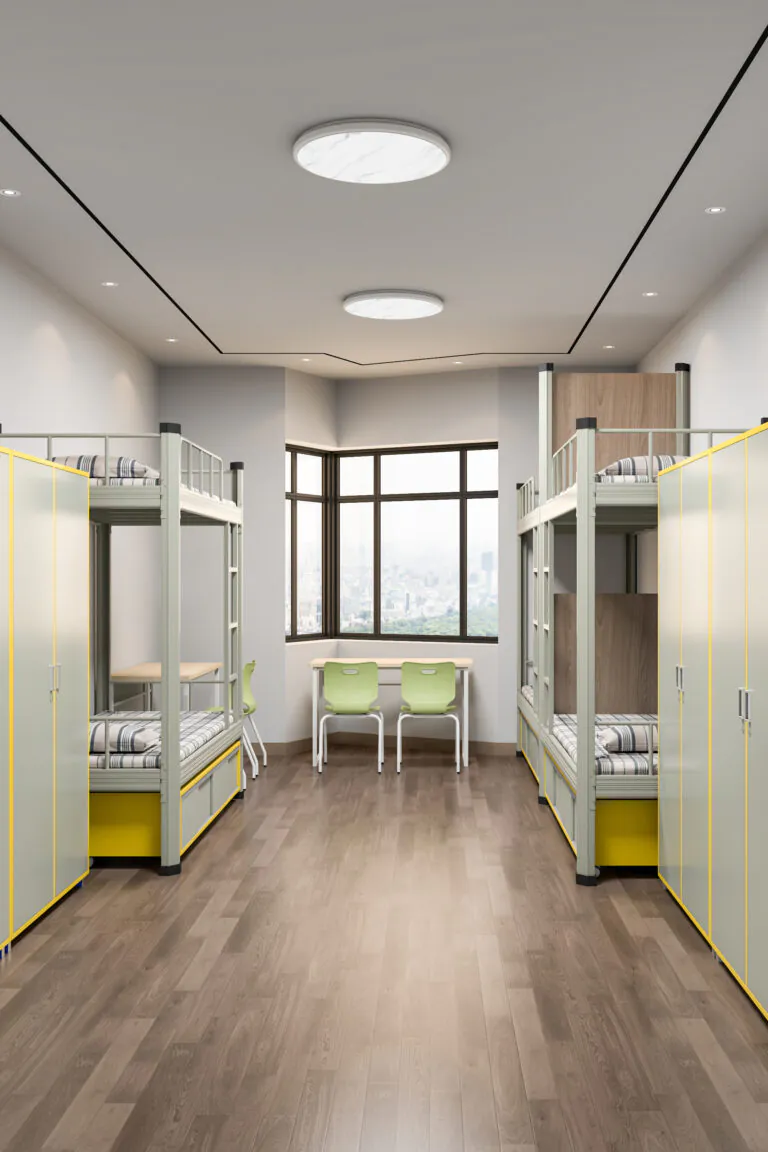
Manufacturers rely on a series of rigorous physical stress tests to ensure that every storage unit can survive the heavy-handed use typical of university life. Testing begins with static load evaluations, where heavy weights are placed on shelves and hooks for extended periods to check for bending or structural failure. These procedures simulate years of holding heavy textbooks, winter coats, and personal electronics. For a facility manager, knowing a dorm cabinet has passed these tests means fewer maintenance calls and a lower risk of accidental collapses. As Topohut Furniture, we serve as a one-stop dormitory and apartment furniture solution provider, focusing on high-density living products that meet strict international safety benchmarks before they ever leave our factory floor.
Dynamic Impact and Door Durability Testing
Beyond holding weight, a dorm cabinet must withstand constant movement, such as doors being slammed or frames being bumped during move-in days. Technicians use specialized machines to open and close locker doors thousands of times—often up to 50,000 cycles—to ensure hinges do not loosen or snap. Impact tests involve dropping a steel pendulum against the side panels to verify that the metal or laminate won’t dent easily or crack under sudden force. At Topohut Furniture, we apply our 30 years of manufacturing experience to build furniture that handles these daily stresses, offering durable designs that stay functional in busy student environments across the globe.
Stability and Anti-Tip Requirements
Safety compliance also focuses heavily on preventing the unit from falling forward, which is a critical concern for any tall dorm cabinet. Testing labs perform “pull-out” tests where all drawers or doors are opened simultaneously to check the balance point. If the unit shows signs of tipping, it must be redesigned or equipped with mandatory wall-anchoring hardware. Stability is measured on both flat and slightly uneven floors to simulate real-world dormitory conditions where carpets or floor tiles might not be perfectly level. We confirm our storage solutions include reinforced base frames and secure attachment points, providing a safer environment for students who might overstuff their lockers.
Surface Resistance and Chemical Safety
The final layer of compliance involves checking how the dorm cabinet reacts to the environment and the chemicals students might use. Surfaces undergo scratch resistance tests using diamond-tipped needles and are exposed to common household cleaners to ensure the finish doesn’t peel or corrode. Additionally, the materials are checked for fire retardancy and low chemical emissions to keep indoor air clean. Because a dorm cabinet is a long-term investment for a school, we prioritize high-grade powder coatings and moisture-resistant boards that pass these environmental hurdles, ensuring the furniture remains hygienic and visually appealing for new cohorts of students year after year.
In summary, the strength of a storage locker is proven through a combination of weight-bearing trials, cycle testing, and stability checks. These technical evaluations ensure that the furniture can handle the chaotic reality of campus living without compromising the safety of the residents. Investing in certified equipment reduces the long-term cost of repairs and gives administrators peace of mind. As a dedicated partner in the industry, Topohut Furniture continues to act as a one-stop dormitory and apartment furniture solution provider, delivering tested, reliable products that meet the high demands of modern student housing projects in over 68 countries.