
Choosing the right bed type is the single most important furniture decision in any student housing project. It determines room capacity, space efficiency, cost per student bed, and the overall living experience — and getting it wrong is expensive to correct after installation.
This guide compares the three most commonly specified space-efficient bed types for student accommodation — Murphy (wall) beds, bunk beds, and loft beds — across every factor that matters to project developers, university procurement teams, and student housing operators.
Table of Contents
ToggleAt a Glance: The Three Bed Types Compared
| Factor | Murphy / Wall Bed | Bunk Bed (2-tier) | Loft / Open Loft Bed |
| Primary benefit | Daytime floor space recovery | Double occupancy in single footprint | Study/storage space beneath elevated bed |
| Occupancy per unit | 1 student | 2 students | 1 student |
| Cost per student bed (factory direct) | $180–$320 | $43–$75 | $90–$160 |
| Space efficiency (daytime) | Highest — 100% floor recovery | Medium — permanent footprint | High — floor beneath usable |
| Ceiling height required | 220cm+ (bed folds into wall) | 220cm+ (upper bunk clearance) | 260cm+ (loft height + clearance) |
| Best room size | 8–15m² studio/single | 10–18m² shared room | 12–18m² single or studio |
| Complexity (student use) | Medium — lift mechanism | Low — standard bed operation | Low — standard ladder access |
| Maintenance requirement | Medium — mechanism service | Low | Low |
| Customization (OEM) | High — integrated desk, sofa, shelving | Medium — colour, size, storage | High — integrated desk, wardrobe |
| Best project type | Premium single, co-living, studio | University dorm, hostel, worker quarters | Single-occupancy premium or standard |
Murphy Beds: Maximum Space Recovery for Single Rooms
A Murphy bed — also called a wall bed or fold-down bed — is a full-size mattress mounted on a mechanism that folds vertically into a wall cabinet when not in use. When closed, the cabinet face can display a desk, shelving unit, or sofa — meaning the room functions as a study or living space during the day and a bedroom at night.
For student housing projects where rooms are used around the clock for both sleeping and studying, Murphy beds offer a genuinely transformative upgrade to room functionality — particularly in rooms under 15m² where a permanent bed would dominate the floor plan.
Where Murphy Beds Work Best
- Studio-style student apartments: where the entire room is one multipurpose space — the Murphy bed creates a clean separation between sleeping and living modes
- Premium single-occupancy dormitories: where perceived room size and quality are differentiators in a competitive student housing market
- Co-living individual units: where daytime common space use is as important as nighttime sleeping
- Urban university sites: where plot constraints limit room footprints and maximum room count per floor is a financial priority
Murphy Bed Specification Essentials
- Wall type: Murphy beds require load-bearing wall attachment. Confirm wall construction (concrete, brick, or steel stud) before specifying — mechanism load ratings vary by installation type
- Lift mechanism: gas piston mechanisms are the current standard — smoother operation, lower maintenance than spring systems
- Integrated desk: fold-down desk integrated into the cabinet front is the most popular student housing configuration — desk is usable when bed is stored, folds away when bed is deployed
- Mattress compatibility: Murphy mechanisms are rated for specific mattress weights. Standard 18–22cm foam mattresses are compatible with most systems; thick hybrid or spring mattresses require mechanism upgrade
- Cabinet finish: visible when bed is closed — specify to match overall room interior
Browse our full range of murphy wall beds — all available with OEM customization and Door-to-Door delivery to Southeast Asia, Middle East, and Africa.
Bunk Beds: The Most Cost-Efficient Solution for Shared Rooms
Bunk beds are the foundational space-saving solution for student dormitories worldwide — and for good reason. By stacking two sleeping positions vertically, a bunk bed accommodates two students in the same floor footprint as a single bed, halving the space-per-student and reducing the bed cost per student by 30–40% compared to two singles.
For university dormitories, student hostels, and worker accommodation where capacity per room and cost efficiency are the primary objectives, bunk beds are the standard specification. They are the most widely used bed type in institutional student housing globally.
Bunk Bed Variants
- Standard 2-tier steel bunk: the industry default for university dormitories. Powder-coated steel frame, 120–150kg weight capacity per tier, modular bolt-together construction for easy assembly and future reconfiguration.
- Triple bunk (3-tier): for maximum density applications — hostels, budget dormitories, worker quarters. Reduces cost per student bed by a further 25–30% vs standard bunks. Requires minimum 280cm ceiling height.
- L-shaped bunk: upper bunk at 90° to lower, creating space beneath and alongside the upper bunk for a desk or storage. Popular for rooms where study space must be integrated with sleeping.
- Bunk with integrated storage: staircase-style access to upper bunk with storage drawers integrated into each step. Higher cost but eliminates need for separate storage in small rooms.
Bunk Bed Specification Essentials
- Steel tube spec: minimum 40×40mm square section, 1.5mm wall thickness for institutional durability
- Weight capacity: minimum 120kg per tier for standard adult student use
- Guard rail height: minimum 20cm above mattress surface on upper bunk (safety requirement)
- Under-bed clearance: specify for lower bunk to confirm compatibility with underbed storage units
- Ladder angle: vertical ladders are space-efficient; angled ladders are more comfortable — specify based on room width availability
Loft Beds: The Best of Both Worlds for Single Rooms
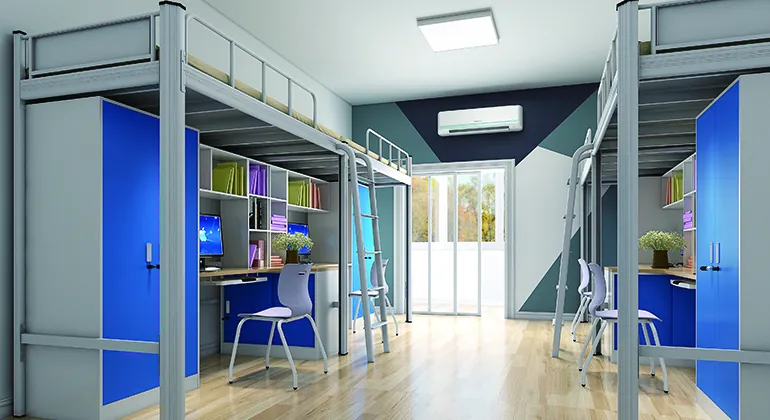
A loft bed elevates the sleeping surface to near-ceiling height — typically 160–190cm above the floor — freeing the entire floor area beneath for a desk, wardrobe, storage, or seating. Unlike Murphy beds, the loft bed is always in position, requiring no daily setup or storage — which makes it simpler to operate and more suitable for standard institutional dormitory use.
Loft beds are the preferred solution for single-occupancy dormitory rooms where the priority is creating a functional, spacious-feeling living and study environment without sacrificing a full-size bed or the room’s ceiling height.
Loft Bed Variants
- Study loft: integrated desk and shelving beneath the elevated bed — the most space-efficient single-room configuration. Desk, shelving, and storage are built into the loft frame.
- Open loft: elevated bed platform only, with floor space beneath used for separately specified furniture. Offers maximum layout flexibility.
- L-shaped loft: bed elevated on one side, desk extending at 90° alongside — maximizes natural light to the study area and creates a clear functional separation between sleeping and working zones.
Loft Bed Specification Essentials
- Ceiling height: loft platform height (typically 160–180cm) + mattress thickness (18–22cm) + minimum 75cm student clearance = minimum required ceiling height of approximately 260–280cm
- Clear height under loft: minimum 130cm for seated desk use; 150cm+ preferred for comfortable use by adult students
- Access: integrated staircase with storage (premium) vs. vertical or angled ladder (standard)
- Guard rail: minimum 30cm above mattress on all open sides
Our full range of open loft beds includes steel and wood/MFC options with full OEM customization available.
Head-to-Head: Which Bed Type for Which Project?
| Project Type | Best Choice | Second Choice | Avoid |
| Large public university dorm, shared rooms | Bunk bed (steel) | Triple bunk | Murphy bed |
| Budget student hostel, maximum density | Triple bunk | Standard bunk | Loft bed |
| Premium single-occupancy student residence | Loft bed | Murphy bed | Bunk bed |
| Studio-style urban student apartment (<14m²) | Murphy bed | Loft bed | Bunk bed |
| Co-living individual unit | Murphy bed | Loft bed | Bunk bed |
| Staff / worker quarters, shared rooms | Bunk bed (steel) | Triple bunk | Murphy bed |
| Private student apartment (university-managed) | Loft bed | Murphy bed | Bunk bed |
Cost Comparison: Per Student Bed
| Bed Type | Unit Cost (FOB China) | Students Accommodated | Cost Per Student Bed |
| Single bed + mattress | $80–$135 | 1 | $80–$135 |
| 2-tier bunk bed + 2 mattresses | $120–$205 | 2 | $60–$103 |
| Triple bunk bed + 3 mattresses | $155–$255 | 3 | $52–$85 |
| Loft bed + mattress | $125–$225 | 1 | $125–$225 |
| Murphy bed + mattress | $215–$385 | 1 | $215–$385 |
FOB China, mid-range specification. Bunk and triple bunk figures show per-student cost based on shared occupancy.
Combining Bed Types in One Project
Many large dormitory projects use different bed types for different room categories — a practical approach that optimizes cost for standard rooms while upgrading the experience in premium units:
- Budget rooms (shared, 3–4 students): triple bunk beds — maximum cost efficiency
- Standard rooms (shared, 2 students): bunk beds — balance of cost and comfort
- Premium single rooms: loft beds — best space efficiency without operational complexity
- Studio suite units: Murphy beds — premium experience, maximum daytime functionality
Topohut supplies all four bed types and can manage multi-category orders as a single project with coordinated delivery schedules.
| Get Specifications and Pricing for All Three Bed Types The Topohut bed frame range covers every student housing bed configuration: Murphy wall beds, 2-tier and triple bunk beds, and open loft beds — all with full OEM customization, ISO/SGS/TUV certification, and Door-to-Door delivery to Southeast Asia, the Middle East, Africa, and South America.
murphy wall beds | open loft beds | MOQ: 100 units | 5–10 year warranty | Free room layout design |
Frequently Asked Questions
Can Murphy beds and bunk beds be used in the same dormitory project?
Yes, and it is increasingly common. Many projects use bunk beds for standard shared rooms and Murphy beds for premium or studio single units. The key is designing each room type independently — Murphy beds and bunk beds have different structural requirements (wall attachment vs. freestanding) and different assembly processes.
Which bed type is the easiest to maintain in a student dormitory?
Bunk beds and loft beds have the lowest maintenance requirement — they are static furniture with no moving mechanisms. Murphy beds have a lift mechanism that requires periodic inspection and occasional gas piston replacement (typically every 5–8 years with normal use). For facilities teams managing large dormitories with limited maintenance capacity, bunk and loft beds are operationally simpler.
What is the minimum room size for each bed type?
Murphy bed: minimum 8m² (bed folds away, room size is the study/living space). Bunk bed: minimum 10m² for a shared double room. Loft bed: minimum 12m² to comfortably accommodate the loft structure plus desk and wardrobe beneath. These are practical minimums — larger rooms allow better furniture arrangement and student comfort.