
Southeast Asia’s university accommodation sector is undergoing significant change. A new generation of students with higher expectations, rapid private university expansion, and government investment in student housing infrastructure are together driving a shift in how dormitory furniture is specified, designed, and procured.
For developers, university facilities teams, and procurement officers planning projects in 2025 and 2026, understanding these trends means specifying furniture that will satisfy students for 10–15 years — and avoiding specifications that will feel outdated within three.
This report draws on procurement data, project experience across Vietnam, the Philippines, Malaysia, Indonesia, and Thailand, and input from university facilities teams to identify the eight most significant trends shaping dormitory furniture specification in Southeast Asia right now.
Table of Contents
ToggleTrend 1: Space Efficiency Is Now the Primary Design Driver
As urban land costs rise across Southeast Asian capitals and secondary cities, dormitory room footprints are shrinking. New builds in Ho Chi Minh City, Manila, Kuala Lumpur, and Jakarta are increasingly in the 10–14m² range for single occupancy — a significant reduction from the 16–20m² rooms common in older campus buildings.
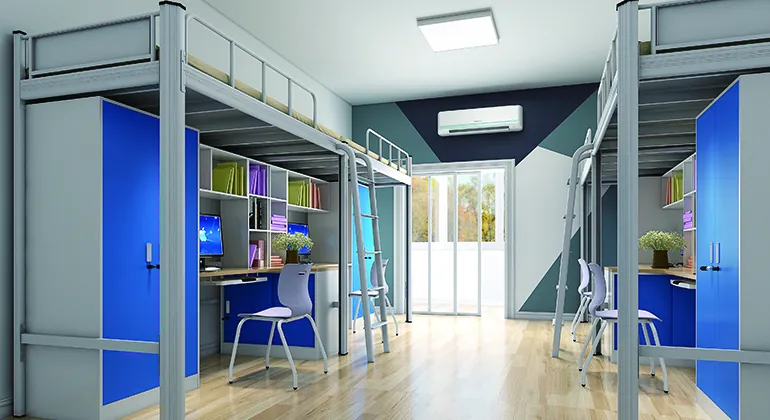
This is driving a fundamental shift in furniture specification: away from standard single beds and standalone wardrobes toward integrated space-saving systems — loft beds with built-in desks and storage, Murphy wall beds for studio-style rooms, and triple bunk beds for budget accommodation.
- Implication for buyers: specify furniture only after confirming room dimensions, ceiling heights, and door widths. A furniture set designed for a 16m² room will not work in a 12m² room, and substituting individual items without system redesign rarely produces a satisfactory outcome.
- Key products in demand: loft beds, Murphy wall beds, integrated study-sleep systems, underbed storage
Trend 2: Multi-Function Furniture Is Replacing Single-Purpose Pieces
The typical dormitory room furniture list of ten years ago — bed, desk, chair, wardrobe, nightstand — is being replaced by multi-function units that combine two or three functions in a single piece, reducing the number of items in the room while increasing functionality.
The most widespread example is the study loft: a single unit combining an elevated bed, integrated desk, shelving, and underbed wardrobe. What previously required five separate pieces of furniture is now one item — with a smaller footprint, faster assembly, and a cleaner aesthetic.
- Why it matters for procurement: multi-function units require OEM manufacturing — they cannot typically be assembled from catalog products. This means longer lead times (40–55 days vs 30–40 for standard products) and more detailed specification work upfront, but lower total per-room cost and better space outcomes.
- Key products in demand: study loft systems, Murphy bed with integrated desk, bunk beds with staircase storage, wardrobe-desk combination units
Trend 3: Durability Expectations Are Rising
Southeast Asian universities and private dormitory operators have learned from a decade of procurement experience that the cheapest furniture specification is rarely the lowest-cost specification over a 10-year horizon. Furniture that fails or deteriorates visibly within 3–4 years creates replacement costs, student dissatisfaction, and reputational damage to the institution.
In 2025, we saw a clear shift toward higher-specification materials and finishes — thicker MFC boards (18mm vs 15mm), heavier steel tube gauges (1.5mm vs 1.2mm), and higher-grade powder coating on metal surfaces. The per-unit cost increase is 8–15%; the extended service life is 3–5 additional years.
- Implication for buyers: include material specifications in your RFQ, not just product descriptions. ’18mm MFC bunk bed’ and ’15mm MFC bunk bed’ look identical in a quote — but perform very differently over 10 years.
- Key specification upgrades: steel tube 40×40×1.5mm (not 1.2mm), MFC board 18mm, powder coat 60–80 microns, ABS edge banding 2mm (not 1mm)
Trend 4: Integrated Charging and Connectivity
The most consistent feedback from student satisfaction surveys across Southeast Asia is the demand for more power outlets and more convenient charging points. In a generation where students routinely use 3–5 devices simultaneously, the standard dormitory room with 2 wall outlets is functionally inadequate.
Furniture manufacturers are responding by integrating USB-A and USB-C charging ports, power outlets, and in some cases wireless charging pads directly into desk surfaces and bedside cabinets. This eliminates the extension cord clutter that characterizes most current dormitory rooms and is increasingly expected by students choosing between accommodation options.
- Specification note: integrated power requires coordination with the building’s electrical design. Confirm power outlet location and type with your M&E consultant before specifying furniture with integrated charging.
- Key products in demand: desks with integrated USB-C and power outlets, nightstands with built-in wireless charging pads, loft beds with power strip integration
Trend 5: ESG and Sustainable Material Sourcing
Environmental, Social, and Governance (ESG) requirements are moving from a checkbox item to a genuine procurement filter across Southeast Asia’s university sector. Private universities competing for international students, and government institutions subject to green procurement policies, are increasingly requiring FSC-certified wood, low-formaldehyde boards (E0 or CARB P2), and suppliers with documented sustainability practices.
This trend is accelerating as Southeast Asian governments align with global sustainability frameworks and as university accreditation bodies — particularly those with European or North American affiliations — introduce environmental standards for campus infrastructure.
- Implication for buyers: if your institution has an ESG mandate or is pursuing building certification (LEED, BREEAM, GreenMark), include FSC certification and E0 formaldehyde emission standard in your supplier qualification criteria — not as a preference but as a mandatory requirement.
- Key certifications in demand: FSC chain of custody, CARB P2 / E0 emission standard, ISO 14001 environmental management
Trend 6: Colour and Design Moving Away from Institutional White
The era of all-white dormitory furniture is ending across Southeast Asia. Students — and the universities and developers competing for them — are recognizing that thoughtfully designed, colour-varied furniture environments improve mental wellbeing, create more memorable living experiences, and serve as marketing differentiators in competitive student housing markets.
The shift is not to bold or complex colour schemes — it is toward warm neutrals (off-white, light timber, warm grey, sage green, dusty blue) combined with natural wood textures that create a residential, hospitality-influenced aesthetic rather than an institutional one. This approach is widely visible in new private university dormitory projects in Malaysia, Vietnam, and the Philippines.
- Implication for buyers: involve an interior designer or specify colour schemes at the RFQ stage. Colour specification after production begins incurs significant change costs and delays. OEM colour customization is standard for orders of 200+ room sets from manufacturers like Topohut.
- Popular 2025 colour directions: warm white + light oak, light grey + natural walnut, sage green + off-white, dusty blue + light pine
Trend 7: Modular and Reconfigurable Furniture Systems
University facilities teams managing dormitory buildings that are 20–30 years old are increasingly facing the need to repurpose spaces — converting quad rooms to doubles, creating accessible rooms, or adapting blocks for different student cohorts. Furniture systems that can be reconfigured without replacement are becoming a procurement priority.
Modular bunk beds that can be separated into two single beds, wardrobe systems with interchangeable internal fittings, and desk units that can be extended or reduced in length are all gaining traction as facilities managers plan for long-term flexibility.
- Specification note: modular capability should be explicitly requested in the RFQ and confirmed in writing. Ask the supplier to demonstrate that separated bunk beds function as standalone singles with proper bed base support and no visible conversion marks.
Trend 8: End-to-End Supplier Services Including DDP and On-Site Installation
The final trend is operational rather than design-based: university procurement teams and private developers across Southeast Asia are increasingly selecting suppliers who can manage the entire supply chain — from factory to installed furniture in the dormitory room — rather than requiring the buyer to coordinate freight forwarding, customs clearance, and installation separately.
Door-to-Door (DDP) delivery and on-site installation coordination, once considered a premium service, is becoming a standard expectation for orders above 200 rooms. Suppliers who can credibly offer this service — with documented experience delivering to Vietnam, the Philippines, Malaysia, Indonesia, and beyond — have a significant competitive advantage in the procurement process.
- What to look for: ask suppliers for specific evidence of DDP deliveries to your country — Bill of Lading copies, customs clearance records, and client references in-country. A supplier claiming DDP capability without this evidence may be overstating their logistics experience.
2025–2026 Trend Summary for Procurement Teams
| Trend | Impact on Specification | Action Required | |
| Space efficiency as primary driver | Specify loft / Murphy / triple bunk beds | Confirm ceiling heights before RFQ | |
| Multi-function furniture systems | Integrated loft-desk-wardrobe units | Allow OEM lead time (40–55 days) | |
| Rising durability standards | 18mm MFC, 1.5mm steel, 2mm ABS edge banding | Include material specs in RFQ | |
| Charging integration | USB-C / outlet integration in desks and nightstands | Coordinate with M&E design | |
| ESG / sustainability | FSC, E0 / CARB P2 certification | Add to supplier qualification criteria | |
| Residential colour direction | Warm neutrals, wood textures | Specify Pantone / RAL codes at RFQ stage | |
| Modular / reconfigurable systems | Bunk beds separable to singles | Request written modular confirmation | |
| DDP / installation service | Full supply chain managed by supplier | Ask for documented DDP delivery evidence | |
| Topohut: Built for These Trends Topohut dorm furniture collection is designed and manufactured specifically for the evolving Southeast Asian university dormitory market. Our product range covers all eight trends above: space-saving integrated systems, OEM colour customization, sustainable certifications (FSC, E0), multi-function units, and full Door-to-Door DDP delivery to Vietnam, the Philippines, Malaysia, and beyond.
Explore our full product range or view completed projects from our portfolio of university dormitory and student housing installations across Southeast Asia, the Middle East, and Africa. | |||
Frequently Asked Questions
What are the most in-demand dormitory furniture products for 2025 in Southeast Asia?
Based on project inquiries and orders, the highest-demand products for Southeast Asian university dormitory projects in 2025 are: steel bunk beds with integrated storage, loft beds with study desks, Murphy wall beds for studio-style rooms, wardrobes with sliding doors, and study desks with integrated USB charging. Space-efficient and multi-function products are consistently prioritized over traditional single-purpose furniture.
Are sustainable furniture requirements increasing in Southeast Asian universities?
Yes, particularly in private universities with international accreditation, government institutions subject to green procurement policies, and projects in Singapore and Malaysia where green building certification (GreenMark, LEED) is more common. FSC certification and E0/CARB P2 formaldehyde emission standards are the most frequently requested sustainability credentials in the current procurement environment.
How long does it take for a Chinese furniture factory to produce custom OEM dormitory furniture?
Standard catalog products: 25–35 days production. OEM products with custom dimensions or colour: 35–45 days. Integrated multi-function systems with custom dimensions: 40–55 days. These timelines apply to orders confirmed with deposit. Add 7–16 days sea freight to Southeast Asian ports and 3–7 days customs clearance for total project planning lead time.