
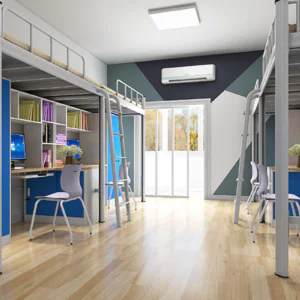
Building a living space for students involves more than just aesthetics; it requires a deep commitment to safety and sustainability. When we source materials for these projects, we look closely at how every board and fabric choice impacts indoor air quality. Students spend a significant portion of their day inside their rooms, studying and sleeping, which makes the emission levels of their desks and wardrobes a high priority. Meeting strict environmental benchmarks ensures that the air they breathe is free from harmful chemicals, creating a healthier atmosphere for academic focus.
Compliance with Low Emission Ratings
The most critical factor in modern cabinetry is the formaldehyde emission level. Standard E1 or Carb P2 certifications are often the baseline, ensuring that the adhesives used in particleboard or MDF don’t off-gas dangerous toxins. We focus on providing student accommodation furniture that utilizes these verified materials to protect long-term health. At Topohut Furniture, we operate as a one-stop dormitory and apartment furniture solution provider, meaning we oversee the selection of these raw materials directly. Our team ensures that every piece, from the bedside table to the large-scale closet, aligns with international safety protocols to give developers and university boards peace of mind.
Sustainable Timber and Material Sourcing
Sourcing wood from responsibly managed forests is another pillar of environmental responsibility. Certification from bodies like the FSC indicates that the timber used in the student accommodation furniture does not contribute to deforestation or habitat destruction. Beyond the wood itself, we consider the recyclability of metal frames and the use of powder coatings instead of traditional liquid paints, which often contain higher levels of volatile organic compounds. By opting for durable, high-quality finishes, the lifecycle of each item is extended, significantly reducing the waste generated by frequent replacements in high-turnover housing environments.
Fire Safety and Non-Toxic Textiles
Soft furnishings and mattresses must meet rigorous fire retardancy standards without relying on hazardous flame-retardant chemicals. It is a delicate balance to verify that fabrics used in student accommodation furniture are both fire-safe and gentle on the skin. We look for textiles that carry Oeko-Tex certifications, confirming they are free from heavy metals and irritating dyes. This level of detail extends to the foams used in seating, where high-density materials provide comfort without breaking down into harmful dust over time. Prioritizing these non-toxic elements creates a safer, more resilient interior that stands up to years of constant use.
Focusing on these environmental standards is a practical investment in the longevity of a housing project and the well-being of its residents. When we select low-emission boards and sustainably sourced metals, we are building a foundation that respects both the planet and the person using the desk. At Topohut Furniture, our core advantage lies in our ability to manage these technical requirements across an entire furniture package. We streamline the process for our clients, ensuring that every room is equipped with furniture that is as safe and eco-friendly as it is functional.